Oregon CDL and Trucking Guide
To get a CDL in Oregon, you pass Oregon DMV's knowledge tests for a commercial learner permit, hold the permit at least 14 days, then pass a three-part skills test with a third-party CDL tester. If it is your first Class A or Class B CDL, federal rules also require entry-level driver training (ELDT) from a provider on FMCSA's Training Provider Registry before you can schedule the skills test.
Last verified: · every fact links to its official source
The official Oregon CDL manual
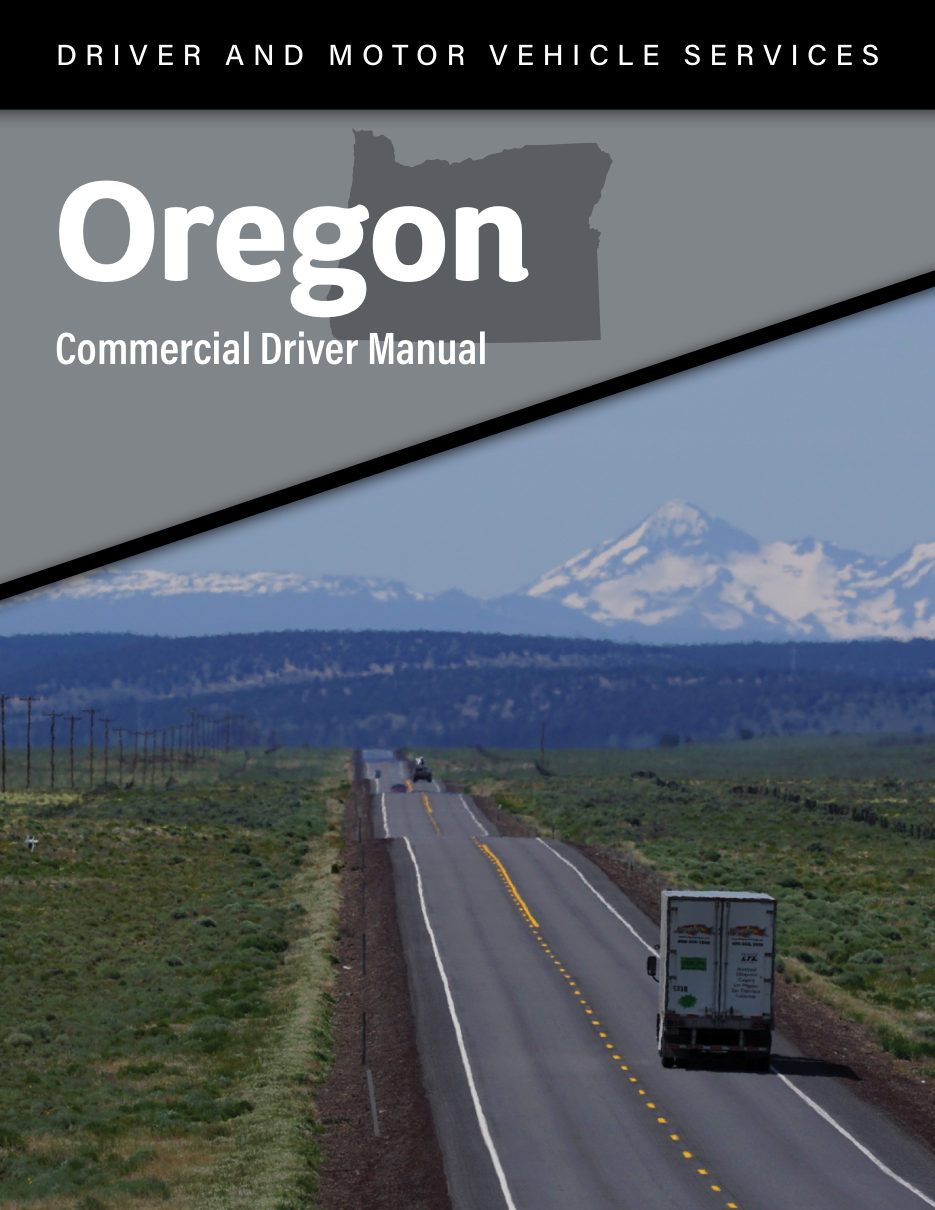
Your permit knowledge tests come from this manual, published by Oregon DOT, Driver and Motor Vehicle Services. Read it right here on the page, or download the PDF to keep on your phone or computer.
Read the manual hereDownload the PDF
Our copy was downloaded from the state on October 14, 2026. The state's own file is always at its official manual link, and the state CDL page lists the newest edition. Link checked October 4, 2026.
Getting a CDL in Oregon
| Licensing agency | Oregon Driver and Motor Vehicle Services (Oregon DMV), part of the Oregon Department of Transportation, issues commercial learner permits and CDLs.[1] |
|---|---|
| Official CDL manual | Oregon Commercial Driver Manual (PDF). If that link moves, use Oregon DMV's manuals and publications page.[2][3] |
| Minimum age | 18 for driving inside Oregon only. You must be 21 to drive a commercial vehicle in interstate commerce. Oregon DMV points out that a trip that stays inside Oregon can still count as interstate if the freight starts or ends outside the state.[1][2][4] |
| Before the permit | You need an Oregon driver license first. You then pass the General Knowledge test, plus Combination Vehicles for Class A and Air Brakes for air brake vehicles. The tests are given in English only.[1] |
| Wait after the permit | You must hold a valid Oregon commercial learner permit for at least 14 days before the skills test.[5][2] |
| Skills test | Three parts: pre-trip vehicle inspection, basic control skills and an on-road driving test. The test is in English only.[1] |
| Where skills tests are given | Oregon DMV's website sends you to a third-party CDL tester. The tester sets its own fee, and the test has to be scheduled at least 48 hours ahead. Anyone who trained you on any part of the skills test cannot be your examiner.[1][5] |
| After you pass | Wait one business day, then go to a DMV office to get the CDL. Knowledge test results and skills test results are each good for six months.[5][1] |
Oregon CDL permit and license fees
These are the fees Oregon DMV publishes for a commercial learner's permit, the tests and a CDL. Each row says who pays it. We list a fee only where the state names it and gives the amount. Checked October 5, 2026.
| Fee | Amount | Who pays it |
|---|---|---|
| Learner's permit and knowledge tests | ||
| Commercial learner permit (valid for 1 year) | $40.00[6] | A first CDL |
| General knowledge testEach commercial knowledge test is $10. If you fail a test, DMV charges the fee each time you take it. | $10.00[6] | A first CDL |
| Air brakes knowledge testApplies only if you take this test (vehicles with air brakes). | $10.00[6] | A first CDL |
| Combination vehicles knowledge test | $10.00[6] | A first CDL: Class A |
| Passenger endorsement knowledge test | $10.00[6] | A first CDL and a CDL holder adding an endorsement: with Passenger |
| School bus endorsement knowledge test | $10.00[6] | A first CDL and a CDL holder adding an endorsement: with School Bus |
| Tank endorsement knowledge test | $10.00[6] | A first CDL and a CDL holder adding an endorsement: with Tank |
| Hazardous materials endorsement knowledge testDMV says the hazardous materials endorsement cannot be applied to a learner permit. The test fee is still $10.00. | $10.00[6] | A first CDL and a CDL holder adding an endorsement: with HazMat |
| Doubles/triples endorsement knowledge testDMV says the doubles/triples endorsement cannot be applied to a learner permit. The test fee is still $10.00. | $10.00[6] | A first CDL and a CDL holder adding an endorsement: with Doubles and Triples |
| Skills test | ||
| CDL skills test at DMVDMV gives skills tests at select locations. If you fail, DMV charges the fee each time you take the test. | $145.00[6] | A first CDL: Oregon DMV |
| CDL skills test with a third-party testerThe tester sets its own fee. DMV does not publish it. | See the note[7] | A first CDL: A third-party CDL tester |
| Passenger endorsement skills test at DMVThe skills test to add any commercial endorsement is $145.00. If you fail, DMV charges the fee each time you take the test. DMV does not say whether adding both passenger and school bus takes one skills test or two; one is shown. | $145.00[8] | A CDL holder adding an endorsement: with Passenger; Oregon DMV |
| School bus endorsement skills test at DMVThe skills test to add any commercial endorsement is $145.00. If you fail, DMV charges the fee each time you take the test. | $145.00[8] | A CDL holder adding an endorsement: with School Bus; without Passenger; Oregon DMV |
| Passenger endorsement skills test with a third-party testerThe tester sets its own fee. DMV does not publish it. | See the note[7] | A CDL holder adding an endorsement: with Passenger; A third-party CDL tester |
| School bus endorsement skills test with a third-party testerThe tester sets its own fee. DMV does not publish it. | See the note[7] | A CDL holder adding an endorsement: with School Bus; without Passenger; A third-party CDL tester |
| License | ||
| Certificate of test completion (third-party skills test)Paid to DMV, on top of the license fee, when you tested with a third-party examiner. | $40.00[6] | A first CDL: A third-party CDL tester |
| Commercial driver license (upgrade of your Oregon license)The same fee whether or not the license has endorsements. | $160.00[6] | A first CDL |
| Certificate of test completion (third-party test, passenger and/or school bus endorsement)Paid to DMV when you took the passenger or school bus endorsement test with a third-party examiner. DMV lists one $40.00 fee for passenger and/or school bus. | $40.00[6] | A CDL holder adding an endorsement: with Passenger; A third-party CDL tester |
| Certificate of test completion (third-party test, passenger and/or school bus endorsement)Paid to DMV when you took the passenger or school bus endorsement test with a third-party examiner. DMV lists one $40.00 fee for passenger and/or school bus. | $40.00[6] | A CDL holder adding an endorsement: with School Bus; without Passenger; A third-party CDL tester |
| Replacement commercial license to add an endorsementThe replacement fee is on top of any test fee. | $30.00[6] | A CDL holder adding an endorsement |
| Fees to move up a class on a commercial license you already holdDMV does not publish what a commercial license holder pays to move up a class: its fee table has no row for it, and no DMV page says which permit, tests or license fee apply. Ask DMV. | See the note[6] | A CDL holder moving up a class |
Not in the table for a first CDL, because we could not confirm the amount from Oregon DMV:
- The third-party tester's own skills test fee, if you do not test with DMV
- The federal HazMat background check, if you add HazMat
Not in the table for a driver who already holds a CDL, because we could not confirm the amount from Oregon DMV:
- All fees for moving up a class (DMV does not publish what a commercial license holder pays)
- A commercial learner permit, if DMV requires one before a passenger or school bus skills test
- A second skills test, if DMV tests passenger and school bus separately
- The third-party tester's own skills test fee, if you do not test with DMV
- The federal HazMat background check, if you add HazMat
Renewal: A commercial driver license renewal is $104.00. DMV says Oregon driver licenses are valid for 8 years.[6]
- A person with no Oregon driver license pays $224.00 for a commercial driver license instead of $160.00.[6]
- Adding or removing a commercial endorsement on a CDL you already hold is $30.00.[6]
- REAL ID is optional and adds $30.00 to the license fee.[9]
- The hazardous materials endorsement needs a TSA security background check with its own fee. DMV does not state the amount.[10]
- If paying by check, DMV asks for a separate payment for the issuance fee and the test fees.[10]
- The $160.00 fee to upgrade an Oregon license to a commercial license is one flat amount. Neither DMV's fee table nor ORS 807.370 changes it for the time left on your current license.[8]
- If you renew your Class C license and upgrade to a commercial license at the same time, DMV lists $214.00.[9]
- If you already hold a CDL, DMV charges $10.00 for each commercial knowledge test you take to add an endorsement.[8]
Fees change. Confirm your total with Oregon DMV before you go. Oregon DMV sets these fees; Red River Valley CDL does not collect them.
Add up your Oregon CDL costs
Getting your permit, your first CDL, adding endorsements, moving up a class or renewing: the CDL cost calculator adds up the Oregon DMV fees above for your class and endorsements, with a source link on every line.
ELDT in Oregon: what has to be done before you test
Entry-level driver training (ELDT) is a federal rule, so it works the same in Oregon as in every other state. If you are getting a Class A or Class B CDL for the first time, upgrading to a Class A or B, or adding a passenger (P), school bus (S) or hazardous materials (H) endorsement for the first time, you have to complete training with a provider listed on FMCSA's Training Provider Registry (TPR).[11]
The state cannot give you the skills test for a Class A or B CDL or a P or S endorsement, or the knowledge test for the H endorsement, until that training is on record.[12] Theory can be done online: the federal definition of theory instruction includes online training.[13] Except for the HazMat endorsement, the theory and behind-the-wheel parts have to be finished within one year of each other.[14]
Oregon DMV follows the federal rule. Its CDL page says you must finish ELDT with a school or other provider on FMCSA's Training Provider Registry before you schedule a CDL skills test or take the hazardous materials endorsement knowledge test. DMV says you do not need the training if you can prove you held a Class A or B CDL, or the passenger, school bus or hazardous materials endorsement, at any time in the past, or if you have a military CDL skills test waiver.[1]
Truck driving jobs and pay in Oregon
| Drivers employed (May 2025) | 23,970[15] |
|---|---|
| Median pay (May 2025) | $61,980 a year, or $29.80 an hour[15] |
| Average pay (May 2025) | $64,080 a year, or $30.81 an hour[15] |
| Projected jobs, 2024 to 2034 | 27,110 in 2024, growing to 28,870 in 2034 (up 6.5%)[16] |
| Projected openings each year, 2024 to 2034 | About 2,980 a year, counting new jobs and replacements[16] |
The wage figures are from the federal Occupational Employment and Wage Statistics survey. The projections come from Oregon's own long-term forecast, published through Projections Central. The two sources give different job totals.
Truck rules on Oregon roads
Size and weight limits
| Width | 8 feet 6 inches[17][18] |
|---|---|
| Height | 14 feet, including the load. The law says the height limit does not excuse a driver from making sure there is enough clearance on the road being used.[17][18] |
| Single vehicle length | 40 feet[17][18] |
| Semitrailer length | 53 feet at most. ODOT's page does not give a kingpin setting.[17] |
| Overall length, tractor and semitrailer | 60 feet overall on Group 1 highways. No overall limit on the designated routes shown on ODOT's Route Map 7, as long as the semitrailer is 53 feet or less.[17] |
| Doubles | On Group 1 highways: 75 feet overall with one trailer no longer than 40 feet, or no overall limit if the two trailers measure 60 feet or less from front to rear, counting the gap between them. On Route Map 7 designated routes the two trailers can measure up to 68 feet.[17] |
| Load overhang | 4 feet past the front bumper. In most cases a load can extend up to 5 feet past the rear of the trailer.[17] |
| Gross weight | 80,000 pounds. Axle groups are also limited by ODOT's Weight Table 1, which is based on axle spacing.[17][18] |
| Single axle | 20,000 pounds, or 600 pounds per inch of tire width, or the tire sidewall rating, whichever is lowest. No single wheel may carry more than 10,000 pounds.[17][18] |
| Tandem axle | 34,000 pounds, or 600 pounds per inch of total tire width, or the tire sidewall rating, whichever is lowest[17][18] |
| Idle reduction and alternative fuel allowance | An extra 550 pounds for a working idle reduction system (APU), and an extra 2,000 pounds for a vehicle fueled by natural gas or electric battery[17] |
ODOT measures these limits against its route maps. Group Map 1 and Route Map 7 show which length limits apply on which highways, so check the maps for the roads you plan to run.
Longer combination vehicles
The federal list of grandfathered longer combinations has Oregon entries for doubles and for triples, both at up to 105,500 pounds gross. Doubles can have up to 68 feet of cargo-carrying length on National Network routes. Triples can have up to 96 feet of cargo-carrying length and 105 feet overall, with trailers of reasonably uniform length, on a list of named routes that includes Interstate 5 from California to Washington. A permit is required over 80,000 pounds, and the federal entry says movement is not allowed when the road is hazardous from ice or snow. The list also has an Oregon truck and trailer combination with up to 70 feet 5 inches of cargo length and 75 feet overall, which needs no overlength permit.[19]
ODOT issues an annual triples permit that allows triples up to 105 feet overall on specified routes, and an annual extended weight permit that allows up to 105,500 pounds gross for tractor-semitrailers, truck and trailer combinations, and doubles.[20]
Truck speed limits
On Interstates, Oregon law sets a lower speed for trucks than for cars. State law sets 55 mph on any highway for a motor truck with a gross vehicle weight rating over 10,000 pounds and for a truck tractor rated over 8,000 pounds, unless a different speed is posted. Cars get 65 mph on Interstates under the same law.[21]
The law names a few stretches with higher limits. On Interstate 84 from the east city limit of The Dalles to the Idaho line, on Interstate 82, and on US 95, trucks get 65 mph and other vehicles get 70 mph. On several other named highways, including US 20 from Bend to Ontario and US 97 from US 197 to the California line, trucks get 60 mph and other vehicles get 65 mph.[21]
Winter restrictions and chains
Oregon's chain law covers every highway in the state. Signs and lighted message boards tell you when you must carry chains and when you must put them on. When signs tell you to carry chains, you need chains in or on the truck that fit and are enough to meet the minimum chain requirements.[22]
Traction tires only take the place of chains on vehicles rated 10,000 pounds or less that are not towing. A truck over 10,000 pounds has to use real chains when signs require them. In very bad conditions ODOT can call a conditional closure and require chains on every vehicle. ODOT says those are frequent in winter on Interstate 5 over Siskiyou Pass south of Ashland.[22]
| Solo truck, single drive axle | One tire on each side of the drive axle[23] |
|---|---|
| Solo truck, tandem drive axles | Two tires on each side of the primary drive axle, or one tire on each side of each drive axle if both axles are powered[23] |
| Tandem-drive tractor with a semitrailer | The same drive axle chains as a solo truck, plus two tires, one on each side, of any axle on the semitrailer[23] |
| Tandem-drive tractor with a semitrailer and a trailer | The drive axle and semitrailer chains above, plus one tire on the front axle and one tire on one of the rear axles of the trailer[23] |
| Penalty | Ignoring a chain sign is a Class C traffic infraction. A commercial vehicle driver can also face a Class A traffic violation for failing to carry and use chains.[22] |
Link chains, cable chains and other devices made to add traction on ice and snow all count as chains. Studded tires are legal in Oregon only from November 1 through March 31. Chain-up areas are for chaining up: ODOT says parking in them is strictly prohibited.
Idling
Oregon law makes it a Class C traffic violation to stop a commercial vehicle with a gross vehicle weight rating over 10,000 pounds and let the main engine idle more than 5 minutes in any continuous 60-minute period. The ticket can go to the driver, the motor carrier or both. Running an APU, a generator set or a reefer unit does not count as idling.[24]
There are exemptions. A truck rated over 26,000 pounds with a sleeper berth can idle for heat or air conditioning during a rest or sleep period when the outside temperature is below 50 degrees or above 75 degrees, but generally not if the truck has an APU or the lot has idle reduction equipment you can use. You can also idle up to 30 minutes while waiting to load or unload or while loading or unloading. Idling in traffic, for defrosters and safety equipment, and for repairs or inspections is also exempt. Cities and counties cannot write new idling rules, but they can enforce ones that were in effect on January 1, 2011.[24]
HazMat routes and tunnels
The federal hazardous materials route registry for Oregon was last updated in 2018. It lists three restrictions and one designated route entry:[25]
- Portland: US 26 from Interstate 405 to State 217, which includes the Vista Ridge Tunnel, is closed to any quantity of hazardous material that has to be marked or placarded.[25]
- East of Pendleton: overnight parking is prohibited for explosives and radioactive materials at the Arrowhead Truck Plaza on Route 331, at the Interstate 84 milepost 216 interchange on tribal land.[25]
- Same interchange: the Wildhorse Casino parking lot next to the truck plaza does not allow parking with any class of hazardous material.[25]
ODOT's Commerce and Compliance Division applies the federal hazardous materials driving and parking rules in 49 CFR Part 397 to carriers and shippers in Oregon. Carriers hauling spent nuclear fuel or highway route controlled quantities of radioactive material have to give ODOT at least 48 hours notice.[26] Check the FMCSA hazardous materials route registry by state and ODOT's HazMat transport in Oregon page before you route a load.
Fuel tax (IFTA) and the weight-mile tax
Oregon has no diesel rate on the IFTA tax matrix.[27] ODOT's Motor Carrier Registration and Tax Manual, revised October 2024, says vehicles operating over 26,000 pounds are subject to weight-mile tax when operating in Oregon.[28]
| IFTA diesel rate, 4th quarter 2026 | None. The IFTA tax matrix lists Oregon with no diesel rate.[27] |
|---|---|
| What heavy trucks pay instead | Weight-mile tax. ODOT's tax manual (October 2024) says it typically applies to commercial vehicles on Oregon public roads with a registration weight over 26,000 pounds. The rate depends on the weight you declare, and you pay for each mile driven in Oregon.[28][29][30] |
| Fuel bought in Oregon | ODOT's tax manual (October 2024) says a truck has to be enrolled in the weight-mile tax program to avoid paying fuel tax at the pump, and that diesel vehicles usually do not pay Oregon fuel tax at the pump. If you are charged Oregon fuel tax, you can claim it as a credit on your weight-mile tax report with the fuel invoice attached.[28][31] |
| Trucks 26,000 pounds or less | ODOT's tax manual (October 2024) says they are exempt from weight-mile tax and pay fuel tax at the pump.[28] |
| Carriers without an ODOT account | Buy a temporary pass before you enter Oregon and carry a paper or electronic copy. It costs $9 plus the weight-mile tax for the miles, and it is good for 10 days or the miles purchased.[30] |
| Who handles it | The ODOT Commerce and Compliance Division. It also issues IFTA licenses to carriers based in Oregon, and those carriers still file an Oregon mileage tax report on top of the quarterly IFTA return.[32][29] |
| Changes coming | ODOT says the weight-mile tax goes from 85 rates to 10 on July 1, 2027, based on registered weight. On July 1, 2029, heavy trucks start paying fuel tax along with a reduced weight-mile tax, and Oregon becomes a full IFTA participant.[33] |
No weight-mile tax rates are quoted here because the rate depends on the weight you declare. Get the current rate tables from the ODOT Commerce and Compliance Division.
Oversize and overweight permits
The ODOT Commerce and Compliance Division issues over-dimension permits through ORION (Oregon Routing Information Online), its self-service system for single trip and annual permits. You need the permit before the load moves, and a commercial carrier needs an ODOT Commerce and Compliance Division account before it can get an ORION account. Start at ODOT's over-dimension permit page.[20]
Truck parking
ODOT lists its rest areas by highway and milepost on TripCheck, along with a rest area map. One to know about: the Siskiyou rest area on northbound Interstate 5, 13 miles north of the California line, does not allow commercial vehicles over 20,000 pounds.[34] ODOT's rest area rules do not let you stay more than 12 hours in any 24-hour period.[35] See the TripCheck list of Oregon rest areas.
Weigh station bypass
Oregon runs its own free preclearance program called Green Light. It checks size, weight, registration and safety records at highway speed and lets compliant trucks bypass ODOT's automated weigh stations. ODOT says the first transponder for each truck is free. To qualify, the truck must be enrolled in the weight-mile tax program and have three or more axles with a registered weight of at least 34,001 pounds.[36]
ODOT says Green Light also works with PrePass transponders, the PrePass mobile app and Drivewyze PreClear at all 21 of its weigh-in-motion sites. You can bypass an open station only on a green light. A truck with an oversize or heavy haul load has to stop at an open scale even with a green light.[36][37]
Help paying for CDL training in Oregon
Oregon keeps an Eligible Training Provider List (ETPL) for Workforce Innovation and Opportunity Act (WIOA) training. The Higher Education Coordinating Commission keeps the list in its LEARN Portal, and a provider and its program both have to be on the list before WIOA money can pay for a participant's training. Oregon also recognizes the lists kept by Idaho, Washington and Utah.[38]
You can search the list in the HECC LEARN Portal training program search.[39]
To ask about funding, contact your local WorkSource Oregon center and ask three things: whether you qualify for WIOA training funds, which CDL programs on the list they will pay for, and what paperwork they need before you enroll. Get the answer before you pay a school.[40]
Veterans and military drivers in Oregon
Oregon military CDL skills test waiver
Federal rules let a state waive the CDL skills test for drivers with military commercial vehicle experience.[41] Oregon does. DMV may waive the Class A or Class B skills test if you are working now, or worked within the last 12 months, in a military job where driving a commercial motor vehicle is one of the main duties. Oregon does not waive the knowledge tests, and it does not waive the passenger or school bus endorsement skills tests.[1][42]
You apply with the Oregon Application for Military Skills Test Waiver (Form 735-7390), signed by you and your commanding officer, with a copy of your DD 214 or military ID and your military vehicle operator's permit. The waiver has to be approved before you go to a DMV office for the CDL. DMV says not to email the application. See the military waiver section of Oregon DMV's commercial driver license page for the steps and mailing address.[1]
GI Bill and VR&E
If you plan to use VA education benefits, check the school first. The VA's GI Bill Comparison Tool lets you look up schools and training programs.[43] Veterans with a service-connected disability can also ask about Veteran Readiness and Employment (Chapter 31).[44] Ask any school whether it is approved for VA benefits before you enroll.
Behind-the-wheel training in Oregon
For a CDL, passenger or school bus endorsement, theory is only half of ELDT. The range and road training has to be done in a truck or bus with a behind-the-wheel provider that is also listed on the Training Provider Registry.[11] The HazMat endorsement is theory only.[45]
To find one near you, use the FMCSA Training Provider Registry provider search: pick the license or endorsement, choose Behind-the-Wheel, and enter your location.[45] You can take theory from one provider and behind-the-wheel from another.
Behind-the-wheel training in Glyndon, Minnesota
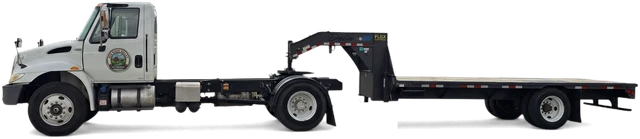
Red River Valley CDL Training is just east of Moorhead and Fargo. Oregon students can train with us here in our truck, or Carl can come to Oregon and train you in your own truck, with travel fees. Your permit, tests and CDL come from Oregon DMV.
Check your Training Provider Registry record
When you finish a course, your training provider has until midnight of the second business day to send your completion to the Training Provider Registry.[46]
You can look it up yourself with FMCSA's Check Your Record tool on the Training Provider Registry. Enter your license or permit number and state, your date of birth, and your first and last name exactly as they appear on your license or permit.[47]
Oregon CDL questions
How old do you have to be to get a CDL in Oregon?
You can get an Oregon CDL at 18 for driving inside the state only. You have to be 21 to drive a commercial vehicle in interstate commerce.[1][2][4]
How long do I have to hold my Oregon CDL permit before the skills test?
At least 14 days. Oregon DMV says you need a valid Oregon commercial learner permit issued at least 14 days before the test, and the test has to be scheduled with a third-party CDL tester at least 48 hours ahead.[5][2]
Does Oregon have a diesel fuel tax for trucks?
The IFTA matrix shows no Oregon diesel rate. ODOT's tax manual (October 2024) says trucks with a registration weight over 26,000 pounds typically pay a weight-mile tax instead, and that diesel vehicles usually do not pay Oregon fuel tax at the pump. ODOT says that on July 1, 2029, heavy trucks start paying fuel tax along with a reduced weight-mile tax.[27][28][33]
What is the truck speed limit in Oregon?
State law sets 55 mph for trucks rated over 10,000 pounds on any highway unless a different speed is posted, while cars get 65 mph on Interstates. On Interstate 84 east of The Dalles, Interstate 82 and US 95, the law gives trucks 65 mph and other vehicles 70 mph.[21]
Do trucks have to carry chains in Oregon?
Yes, whenever signs say so. Signs and message boards tell you when to carry chains and when to put them on, and the chain law covers every highway in the state. A truck over 10,000 pounds cannot use traction tires in place of chains.[22]
Other state guides
Researching another state? ELDT.Courses keeps sourced guides for all 50 states and DC at eldt.courses/states.
Where these facts come from
Every fact on this page comes from an official source that was opened and read on the date shown. Click a source to read it yourself. Rules, fees, rates and wages change, so check the source before you rely on a number.
- Oregon Driver and Motor Vehicle Services (ODOT). Getting a Commercial Driver License or Commercial Learner Permit. Checked October 4, 2026.
- Oregon Driver and Motor Vehicle Services (ODOT). Oregon Commercial Driver Manual, Form 735-36m (10-25). Checked October 4, 2026.
- Oregon Driver and Motor Vehicle Services (ODOT). DMV Manuals and Publications. Checked October 4, 2026.
- eCFR. 49 CFR 391.11, General qualifications of drivers. Checked October 4, 2026.
- Oregon Driver and Motor Vehicle Services (ODOT). Commercial Skills Test (third party CDL testers). Checked October 4, 2026.
- Oregon DMV. CDL Fees (CDL Fees On or After January 1, 2024). Checked October 5, 2026.
- Oregon DMV. Third Party CDL Testing. Checked October 5, 2026.
- Oregon Legislature. ORS 807.370, License, endorsement and permit fees. Checked October 5, 2026.
- Oregon DMV. Driver Licensing & ID Card Fees. Checked October 5, 2026.
- Oregon DMV. Oregon Commercial Driver Manual, Form 735-36m (10-25). Checked October 5, 2026.
- eCFR. 49 CFR 380.609, General entry-level driver training requirements. Checked October 4, 2026.
- eCFR. 49 CFR 383.73, State procedures. Checked October 4, 2026.
- eCFR. 49 CFR 380.605, Definitions (theory instruction). Checked October 4, 2026.
- eCFR. 49 CFR 380.603, Applicability (entry-level driver training). Checked October 4, 2026.
- U.S. Bureau of Labor Statistics. Occupational Employment and Wage Statistics, Oregon, May 2025. Checked October 4, 2026.
- Projections Central (Projections Managing Partnership). Long-Term Occupational Projections (2024-2034). Checked October 4, 2026.
- ODOT Commerce and Compliance Division. Legal Vehicle Dimensions (vehicle weight and size). Checked October 4, 2026.
- Oregon Legislative Assembly. Oregon Revised Statutes Chapter 818, Vehicle Limits (ORS 818.010, 818.080). Checked October 4, 2026.
- eCFR. 23 CFR Part 658, Truck size and weight, route designations (including Appendix C). Checked October 4, 2026.
- ODOT Commerce and Compliance Division. Over-Dimension Operations in Oregon (get an over-dimension permit). Checked October 4, 2026.
- Oregon Legislative Assembly. Oregon Revised Statutes Chapter 811, Rules of the Road for Drivers (ORS 811.111, Violating a speed limit). Checked October 4, 2026.
- ODOT TripCheck. Oregon Chain Law. Checked October 4, 2026.
- ODOT TripCheck. Minimum Chain Requirements. Checked October 4, 2026.
- Oregon Legislative Assembly. Oregon Revised Statutes Chapter 825, Motor Carriers (ORS 825.601 to 825.615, idling). Checked October 4, 2026.
- FMCSA. National Hazardous Materials Route Registry: Oregon (last updated May 31, 2018). Checked October 4, 2026.
- ODOT Commerce and Compliance Division. HazMat Transport in Oregon. Checked October 4, 2026.
- IFTA, Inc.. IFTA Tax Matrix, 4th Quarter 2026 Fuel Tax Rates. Checked October 4, 2026.
- ODOT Commerce and Compliance Division. Oregon Motor Carrier Registration and Tax Manual (revised October 2024). Checked October 4, 2026.
- ODOT Commerce and Compliance Division. Weight-Mile Tax Program Enrollment. Checked October 4, 2026.
- ODOT Commerce and Compliance Division. Weight-Mile Temporary Tax Pass. Checked October 4, 2026.
- ODOT Commerce and Compliance Division. Use Fuel License and Taxes. Checked October 4, 2026.
- ODOT Commerce and Compliance Division. Interstate Operations / IFTA Requirements. Checked October 4, 2026.
- ODOT Commerce and Compliance Division. CCD Modernization Projects (House Bill 3991 weight-mile tax changes). Checked October 4, 2026.
- ODOT TripCheck. Oregon Rest Areas. Checked October 4, 2026.
- ODOT TripCheck. Rules of Use for ODOT Rest Areas. Checked October 4, 2026.
- ODOT Commerce and Compliance Division. Green Light Preclearance Program. Checked October 4, 2026.
- ODOT Commerce and Compliance Division. Oregon Weigh Stations. Checked October 4, 2026.
- Oregon Higher Education Coordinating Commission. Eligible Training Provider List. Checked October 4, 2026.
- Oregon Higher Education Coordinating Commission. HECC LEARN Portal: Training Programs (Eligible Training Provider List). Checked October 4, 2026.
- WorkSource Oregon. Contact a WorkSource Center. Checked October 4, 2026.
- eCFR. 49 CFR 383.77, Substitute for knowledge and driving skills tests for drivers with military CMV experience. Checked October 4, 2026.
- Oregon Driver and Motor Vehicle Services (ODOT). Oregon Application for Military Skills Test Waiver, Form 735-7390 (4-26). Checked October 4, 2026.
- U.S. Department of Veterans Affairs. GI Bill Comparison Tool. Checked October 4, 2026.
- U.S. Department of Veterans Affairs. Veteran Readiness and Employment (Chapter 31). Checked October 4, 2026.
- FMCSA. Training Provider Registry: Find a Provider. Checked October 4, 2026.
- eCFR. 49 CFR 380.717, Training certification. Checked October 4, 2026.
- FMCSA. Training Provider Registry: Check Your Record. Checked October 4, 2026.
Last verified October 4, 2026. General information, not legal advice. State research by ELDT.Courses.